Japanese version is available here: https://www.the-n.jp/column/indian-menu-naming-japanese/
“We’re confident about the taste, but first-time customers ‘stop at the moment of ordering’.”—this is a common situation in Indian restaurants.
The cause is not a lack of appeal in the food, but the fact that customers can’t picture the dish from the menu name, and it leaves them feeling unsure.
In this article, while valuing cultural charm and respect, we summarize practical ways (formats, templates, placement) to refine menu wording into “words that come across to people in Japan”.
Why orders stop when menu names don’t come across
Key points of this section
For first-time visitors, it becomes easier to order when they can imagine “taste, spiciness, portion size, and ingredients.”
With menu names, what matters is not “translation,” but helping imagination.
First-time customers are thinking something like this while looking at the menu:
“What does it taste like?” “Is it spicy?” “How big is it?” “Will it suit me?”
If they can imagine this in an instant, ordering goes smoothly. On the other hand, when only proper dish names are listed, it can easily turn into “I don’t understand = I’m scared,” and they stop.
What matters is not erasing the dish name (the cultural name).
Keep the name, and add a short, easy-to-understand supplement—this is the proven way to raise ordering rates while keeping an authentic feel.
Five conversion rules to change menu names into words that “hit”
Key points of this section
Use “proper name + reading + one-line description + main ingredient” as the basic format.
If you also add “how to choose (recommendation guidance),” hesitation decreases.
Rule ①: Add the reading (Katakana / furigana)
If people can’t read it, they may immediately feel “this might be difficult for me.”
Simply adding the reading next to the dish name lowers the psychological hurdle.
Rule ②: Fix the flavor “type” in one short phrase
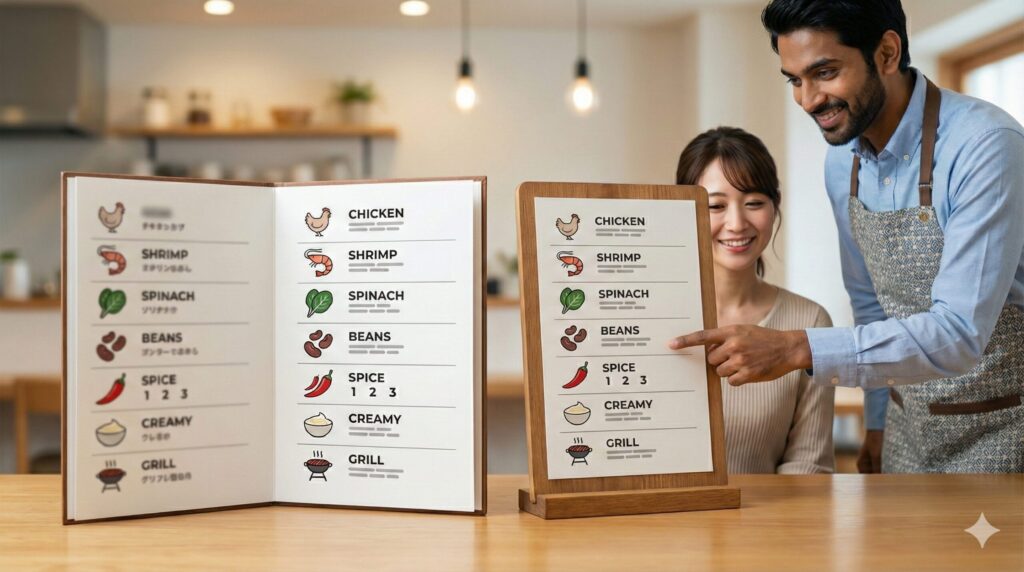
Examples: “トマトクリーミー,” “スパイス香る,” “豆の旨み,” “香ばしグリル,” etc.
Rather than long explanations, the right answer is a short phrase that shows the direction of the taste.
Rule ③: Make the main ingredient visible (chicken, beans, spinach, etc.)
Questions like “What meat is it?” “Does it include dairy?” can become brakes on ordering.
If you put the main ingredient (chicken / lamb / shrimp / beans / spinach, etc.) into the dish name, it becomes easier to understand.
Rule ④: Prepare a recommended “entry” (wording that doesn’t feel pushy)
Labels like “for beginners” can feel uncomfortable depending on the person.
Instead, place a gentle guide such as a pathway like “if you’re unsure, start here”.
- ■
迷ったらこちら(人気メニュー) - ■
辛さ控えめも可能です(お好みで調整)
Rule ⑤: Name set menus by the “reason” (stronger than a “shop name set”)
Compared to “Set A / Set B,” names that show the reason to choose sell better.
Examples: 「しっかり満足セット」/「迷ったら安心セット」/「スパイスしっかりセット」
Ready to use: the “format” for menu names and Before/After examples
Key points of this section
The strongest approach is to run “proper name (reading) + one-line description” side by side.
While respecting the “cultural name,” you can reduce hesitation when ordering.
It’s easier if you remember this as a template.
Recommended basic format:
“Proper name (reading)” + “one-line taste description” + “main ingredient”
Example: ◯◯(◯◯)/トマトクリーミー/鶏
| Before (proper name only) | After (example that comes across) | Tips for the supplement |
|---|---|---|
| Butter Chicken | バターチキン(バター香るトマトクリーミー) | Keep “sweetness / richness / creamy” short |
| Palak Paneer | パラックパニール(ほうれん草×チーズの濃厚カレー) | Make ingredients (spinach / cheese) explicit |
| Dal | ダール(豆の旨み/やさしいスパイス) | Add reassuring words like “gentle” |
| Chicken Tikka | チキンティッカ(香ばしタンドールグリル) | Show the cooking method (baked / grilled) first |
| Biryani | ビリヤニ(スパイス香る炊き込みご飯) | “炊き込みご飯” makes it instantly clear |
*The “After” examples above are examples of the “writing format.” Since actual taste, ingredients, and spiciness vary by shop, please adjust to match the facts (it’s also thoughtful to add a short note for those concerned about allergies).
If you change the “arrangement,” best-sellers become even easier to understand
Key points of this section
For first-time visitors, categories by “how to choose” work better than categories by “dish genre.”
The trick is to create an exit (a recommended frame) for people who hesitate.
Split categories by “how to choose”
For example, if you classify like the following, it becomes much easier to choose.
- ■迷ったらこちら(人気メニュー)
- ■しっかり満足(ボリューム)
- ■スパイスしっかり(香り重視)
- ■辛さ控えめもOK(お好みで調整)
Fix-display “three recommendations”
Instead of “today’s recommendations,” placing three classic picks that first-time visitors won’t get stuck on at the top of the menu is strong.
(Example: tomato-creamy type / bean-umami type / fragrant grilled type)
If you align the same wording across the storefront, Google, and the web, anxiety before visiting decreases
Key points of this section
Align menu names with the same notation across entry (storefront) → Google → inside the shop.
When the words match what people saw beforehand, they tend to order with more confidence.
Google Business Profile: set the menu URL
Before visiting, many people check the shop via Google Search / Google Maps.
Google Business Profile provides guidance that you can register a link to your menu (Menu link).
(Source: Google Business Profile Help: Menu editor (Menu link))
Posts: briefly introduce “three recommendations”
Weekly recommendations and set menu guidance can be shared regularly using the Posts feature.
If you write briefly in the “proper name + one-line description” format, it’s easier to read.
(Source: Google Business Profile Help: Create & manage posts)
Photos: help imagination with three points—exterior, interior, and dishes
When people can see “the entrance,” “the atmosphere inside,” and “what the dishes look like,” it builds confidence.
Google provides guidance such as taking exterior photos from multiple directions and adding interior photos as well.
(Source: Google Business Profile Help: Tips for business photos/
Manage photos & videos)
Use ChatGPT / Gemini to mass-produce “wording alternatives that hit” (with a tone setting that won’t be rude)
Key points of this section
If you provide the dish characteristics (taste / ingredients / spiciness / cooking method), you can generate candidates.
However, fact-checking and notation consistency are essential in the end.
At the N, we use ChatGPT and Gemini to create first drafts of menu wording.
The key is to specify the tone up front: “respect the culture, and do not label people”.
Copy-and-paste prompt (menu name rephrasing / standardization)
あなたは飲食店のメニュー編集者です。
次の料理情報をもとに、メニュー名を「固有名(読み)+一言説明」の型で提案してください。
文化や背景への敬意を大切にし、相手をラベリングする表現(例:「日本人向け」など)は使わず、誰が見ても心地よい丁寧な日本語で書いてください。
【料理情報】
・固有名(英語表記または現地名):____
・読み(カタカナ):____
・主役食材:____(鶏/羊/海老/豆/ほうれん草 等)
・味の特徴:____(例:トマトクリーミー/スパイス香る/豆の旨み/香ばしグリル)
・辛さ:____(0〜5など。調整可能なら「調整可」と明記)
・注意点:____(乳製品使用など。事実のみ)
【出力形式】
1) メニュー名(短め)を3案
2) 一言説明(15〜25文字)を3案
3) Google投稿用(90〜120文字)を1案(おすすめ3品をまとめる)
4) 店頭POP用(7〜15文字)を2案
Google explains that adding “structured data (Structured Data)” on the website side can make it easier for search engines to understand page content.
For example, for restaurants, there is an idea of linking a menu (hasMenu) to the schema.org “Restaurant” type (if you implement it, web production will need proper design).
(Source: Google Search Central: Introduction to structured data/
schema.org: Restaurant (hasMenu))
Frequently Asked Questions (FAQ)
Key points of this section
It’s OK to keep proper names. What changes whether orders stop is whether there is a “one-line description”.
Prioritize design that reduces hesitation.
Q. If we change proper names, won’t it reduce the “authentic” feel?
A.
It won’t. The proven approach is to keep the proper name and add the reading and a one-line description. While respecting the cultural name, you can reduce hesitation for first-time visitors.
Q. Should we avoid wording like “for beginners”?
A.
Because it can be received differently depending on the person, wording like 「迷ったらこちら」「人気メニュー」 that feels natural for anyone is recommended.
Q. Which should we fix first: Google or the paper menu?
A.
First, improve the Google side that people are likely to see before visiting (menu link, posts, photos), and then unify the wording with the paper menu. This is the smoothest flow.
Summary: Menu names that “hit” are “proper name + one-line description + easy-to-choose categories”
Key points of this section
Don’t erase the dish name—add help for imagination.
That alone can reduce “stopping at ordering.”
Changing menu names is not “pandering,” but a translation design that conveys your shop’s appeal correctly.
Starting today, try changing just your top three popular dishes into “proper name (reading) + one-line description.” It’s easier to see results.
“We want to redo the menu sheet, do photo shooting, improve Google, and publish on the web—all together.”
In that case, the N can help with “small-start design”.
If you want to start small with “photo shooting + LP + Google Business Profile,” the N’s Small-Start Design Pack can be an option.
▶ View plan details
Not a monthly payment—start from a one-time “50,000 yen and up”.
the N fully supports the “first step” of businesses in Edogawa City.
First, please tell us about your business.
Or feel free to reach out via Instagram DM (@the.n.sns).
[Communication note]
I am not a fluent English speaker, and English is not my strong skill.
For meetings or detailed discussions in English, we will mainly use translation tools (including AI-based translation).
Because of this, there may be cases where communication is not conveyed 100% perfectly.
However, I will always take time to confirm details carefully, ask follow-up questions when needed,
and make sure we reach a shared understanding before proceeding.
Please feel free to use simple English.