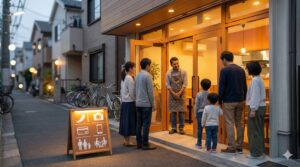
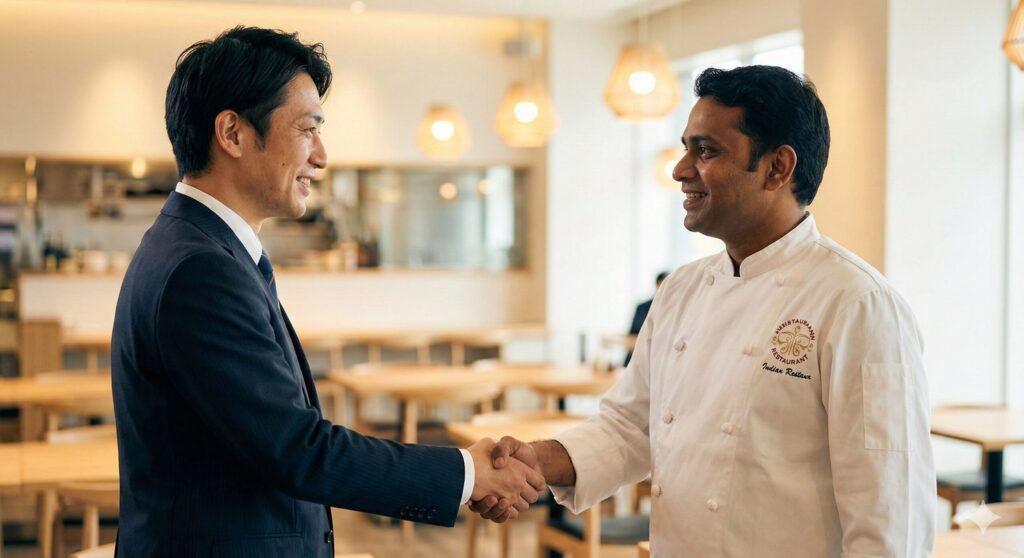
Edogawa City—especially the Nishi-Kasai area—is a place where you can enjoy wonderful food cultures from around the world, including authentic Indian cuisine, Chinese food, and Asian dining. However, even if you are serving great food, have you ever felt that “for some reason Japanese customers seem hesitant to come in,” or that “customers beyond regulars don’t increase”?
The cause may not be the taste, but “how it’s communicated.” In this article, for owners from overseas, we explain “design and Japanese localization (optimization)” that captures Japanese customers’ hearts.
What “sense of reassurance” do Japanese customers look for when entering a “new-to-them restaurant”?
Key takeaway of this section
Japanese people often have a strong desire to “avoid mistakes,” so before entering, they carefully check “menu details” and “the atmosphere inside.” If the information is vague, even a delicious restaurant tends to be removed from their options.
“If you serve delicious food, customers will come.”
This is a chef’s pride—and it’s true. However, for Japanese customers visiting for the first time, the biggest hurdle is the psychological barrier of “Is it okay to go into this place? (a sense of reassurance)”.
According to one survey, when Japanese people choose a restaurant, about 70% cite “how easy it is to understand the menu and product information” as an important factor.
(Source: Referencing Toreta “Survey on dining out,” etc.)
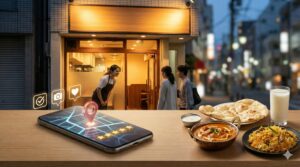
In other words, the moment they look at your storefront sign or website, if the following three things are not clearly communicated, Japanese customers will hesitate to enter.
- ■ What kind of food it is (can they imagine the taste?)
- ■ How much it costs (prices clearly stated)
- ■ Cleanliness and the overall atmosphere inside
Overcome the language barrier. “Cultural localization” with AI × professional expertise
Key takeaway of this section
What matters is not just “translation,” but “localization”—converting wording into phrases that spark Japanese customers’ appetite. By leveraging AI while using design to convey cleanliness, your ability to attract customers can improve dramatically.
So what should you do specifically? The key is not to translate your native language into Japanese as-is, but to adapt it to “expressions Japanese people prefer” (localize it).
1. The pitfalls of “literal translation” menus and improvement examples
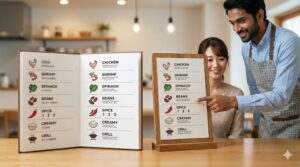
A common issue seen at many restaurants is a menu that simply writes dish names in katakana. With that, the appeal of the dish doesn’t come through.
At the N, we use the latest AI such as Gemini and ChatGPT, and then add professional copywriting to propose “menu names that make people want to order.”
| Common wording (literal) | Wording that resonates with Japanese customers (localized) |
|---|---|
| Chicken curry With only this, it’s hard to imagine the flavor | Fragrant with 10 spices fall-apart tender chicken curry Conveys “aroma” and “texture” to stimulate appetite |
| Spicy noodles May be perceived as “just spicy” | Spicy & savory! Addictive house-special spice noodles Emphasizes “umami” and encourages repeat visits |
2. The magic of design that creates “approachability”
Japanese customers place great importance on “cleanliness (Cleanliness).” In website and menu design, simply covering the following points will significantly boost trust.
- ✅ Use generous whitespace: Don’t cram in too much information—keep it clean and uncluttered.
- ✅ Bright photos: Use appetizing food photos that look like they were taken in natural light—bright and sizzling.
- ✅ Font selection: Appropriately use fonts Japanese people are used to reading, such as “Gothic” or “Mincho,” depending on context.
Frequently Asked Questions (FAQ)
Q. I’m not very confident in Japanese—can I still consult with you?
A. Absolutely.
At the N, we can communicate using translation AI tools. Please speak in your native language about your “vision” and your “commitment to your cuisine” without worrying about the language barrier. We will convert it into a form that resonates with Japanese customers.
Q. Can I ask for only the menu rewriting?
A. Yes, we’d love to help.
Not only websites, but we also handle redesigns for in-store menu books, posters, and signage. We also support a small start like “first, fix the menu and see how people respond.”
Conclusion: Energize Edogawa City with great food—beyond borders
Your restaurant already has “excellent food.” Now, all that remains is to “communicate it properly” to Japanese customers. Language and cultural barriers can be overcome easily with the power of design and AI. The N will fully support owners from overseas who are working hard in Edogawa City, as your dedicated business partner.
Not a monthly payment—starting from a one-time “50,000 JPY+.”
From Japanese menu rewrites to full website localization.
First, tell us about your business.
Or feel free to contact us via Instagram DM (@the.n.sns).
Communication note
I am not a fluent English speaker, and English is not my strong skill.
For meetings or detailed discussions in English, we will mainly use translation tools (including AI-based translation).
Because of this, there may be cases where communication is not conveyed 100% perfectly.
However, I will always take time to confirm details carefully, ask follow-up questions when needed,
and make sure we reach a shared understanding before proceeding.
Please feel free to use simple English.